HomeUnmanned Ground & Surface Vehicles (UGV / USV)FlySpark AM400 Ackermann Steering Robot Chassis | Wheeled UGV, ROS Robot Car, 20kg Payload, 40km Range, 6.5km/h, Drive-by-Wire & CAN 2.0B ROS1/ROS2 SDK
1 / 16
Category
Unmanned Ground & Surface Vehicles (UGV / USV)
Status
ACTIVE
Variants
5
Spec fields
49
Unmanned Ground & Surface Vehicles (UGV / USV)In stock
FlySpark AM400 Ackermann Steering Robot Chassis | Wheeled UGV, ROS Robot Car, 20kg Payload, 40km Range, 6.5km/h, Drive-by-Wire & CAN 2.0B ROS1/ROS2 SDK
FlySpark AM400 Ackermann Steering Robot Chassis | Wheeled UGV, ROS Robot Car, 20kg Payload, 40km Range, 6.5km/h, Drive-by-Wire & CAN 2.0B ROS1/ROS2 SDK — available for export to United Kingdom. Indicative price Quote on request (GBP, ex-works). Formal quote, lead time and end-user documentation on WhatsApp.
FlySpark AM400 Ackermann steering robot chassis: ROS wheeled UGV with 20kg payload and 40km range for autonomous driving research. India & export.
Base price
POA
Excl. GST · Final pricing subject to configuration & quantity
Orders are confirmed by our sales desk on WhatsApp with a quote in GBP.
Get Quote on WhatsAppRequest Quote by EmailPrice on application — WhatsApp us for pricing and lead time.
Qty1
Military-grade quality assured
Export-compliant documentation
24/7 engineering support
System Tags
flysparkam400flyspark-am400ackermann-steering-robot-chassisackermann-robot-chassisackermann-steering-ugvros-robot-carros-robot-car-platformros-robot-platformros2-robot-chassiswheeled-ugvwheeled-ugvs
Mission configurations
Configuration(5)
Select your operational configuration. Pricing may vary — request a formal quote for deployment quantities.
Configuration matrix
Compare all variants
Side-by-side specifications — click a column to select
| Parameter | |||||
|---|---|---|---|---|---|
| Unit Price (GBP, ex-works) | POA | POA | POA | POA | POA |
| Stock | Available | Available | Available | Available | Available |
| SKU | FSP-AM400-UGV-STANDARD | FSP-AM400-UGV-20AH | FSP-AM400-UGV-NAV | FSP-AM400-UGV-DOCK | FSP-AM400-UGV-EDU |
Intelligence Brief
Mission overview
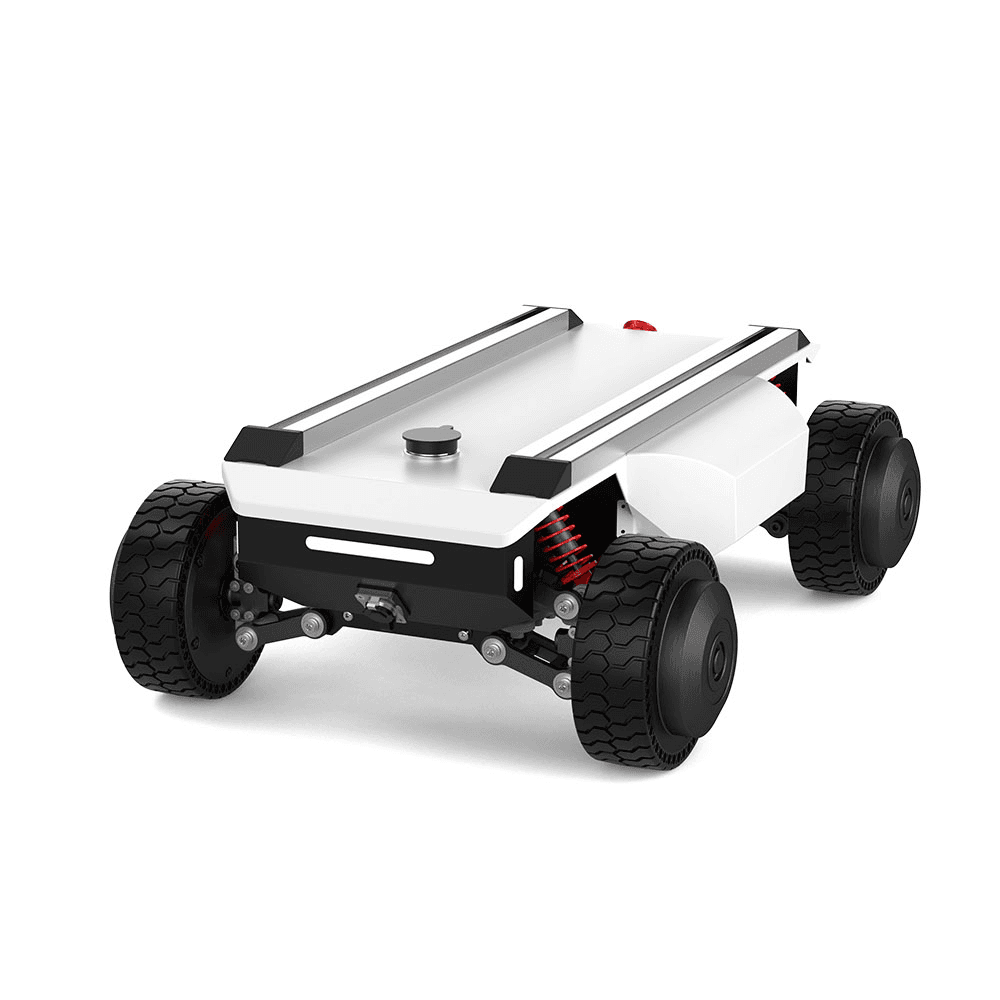
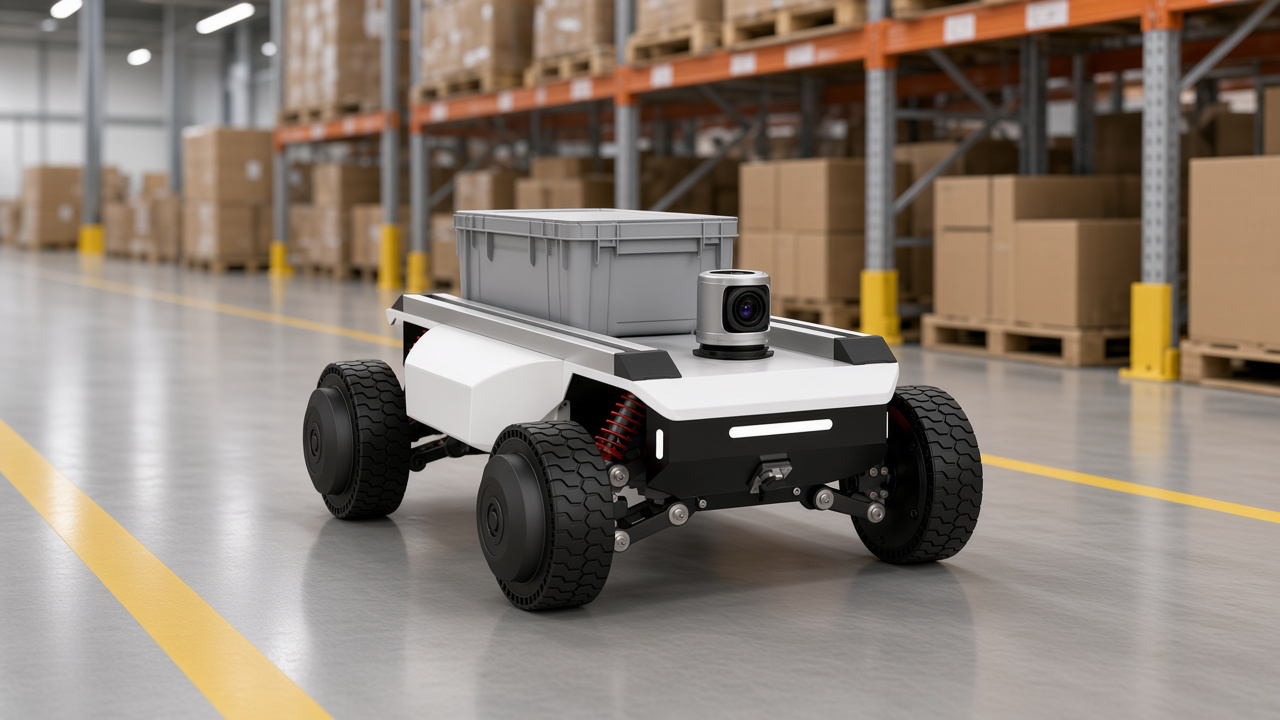
FlySpark AM400 is a lightweight, high-precision Ackermann steering robot chassis – a car-like wheeled UGV built for researchers, educators and developers who need a realistic test vehicle for autonomous driving, ROS navigation and modular robotics. It weighs just 18kg, carries a 20kg payload, reaches 6.5km/h and covers about 40km per charge unladen on its standard 24V 10Ah battery, or up to 80km with the optional 24V 20Ah pack.
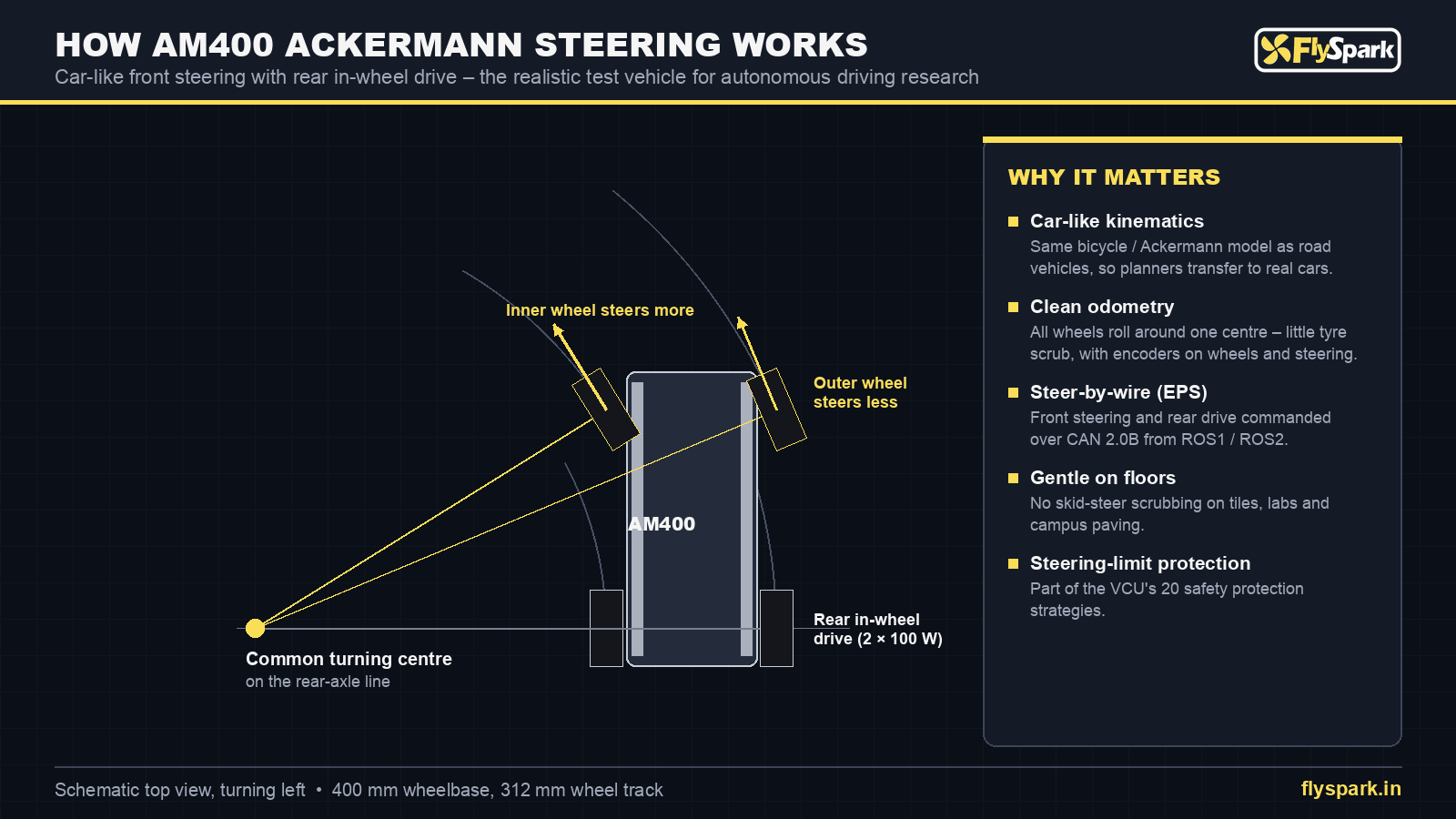
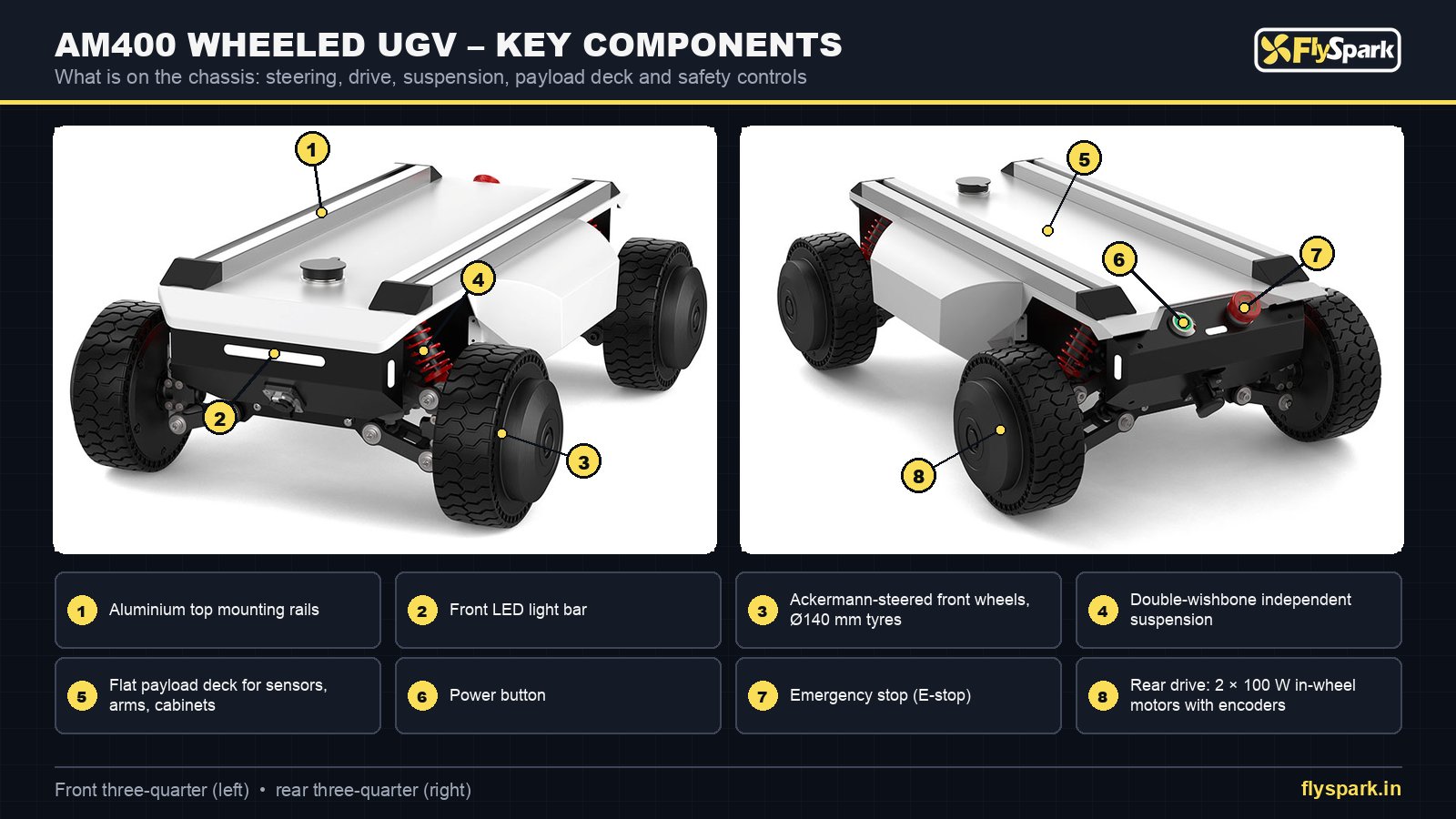
The AM400 is part of the FlySpark Unmanned Ground & Surface Vehicles (UGV / USV) range and is the most compact ROS robot car platform in the family. Unlike skid-steer robots, it uses true front Ackermann steering with rear motor drive, so its wheels roll around a common turning centre just like a passenger car. Two 100W sealed in-wheel motors give quick response and strong torque, while high-precision encoders on both the wheels and the steering system deliver clean odometry for SLAM, path planning and end-to-end autonomous driving. Double-wishbone independent suspension on all four wheels absorbs shocks, protects mounted sensors and keeps the tyres planted on paving, campus roads, gravel paths and factory floors.
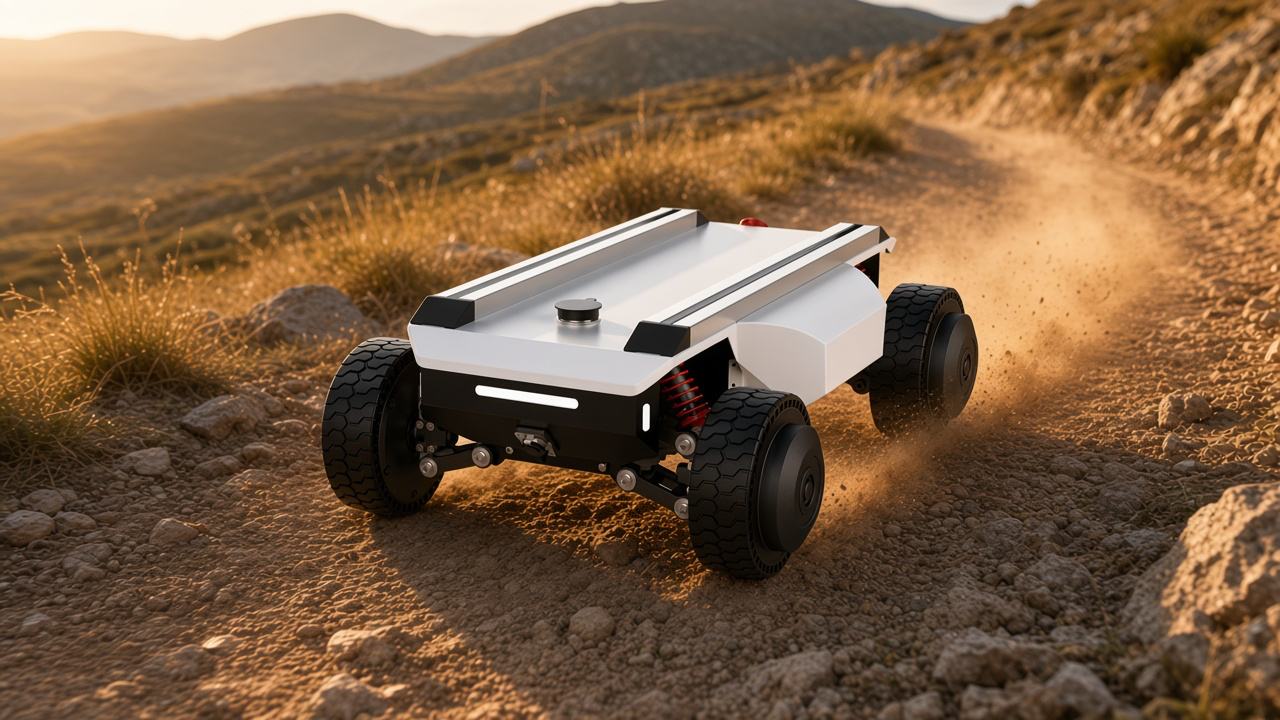
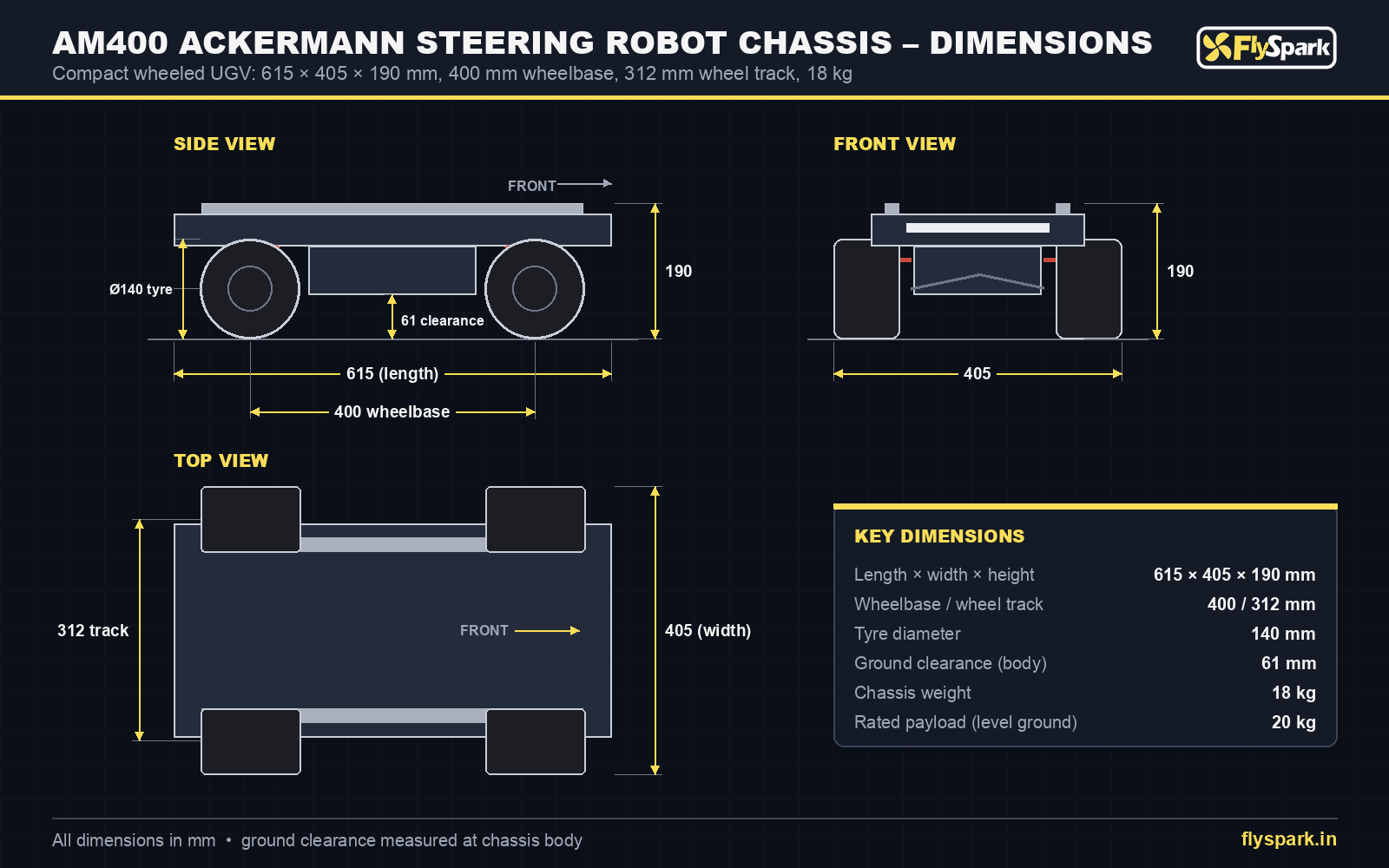
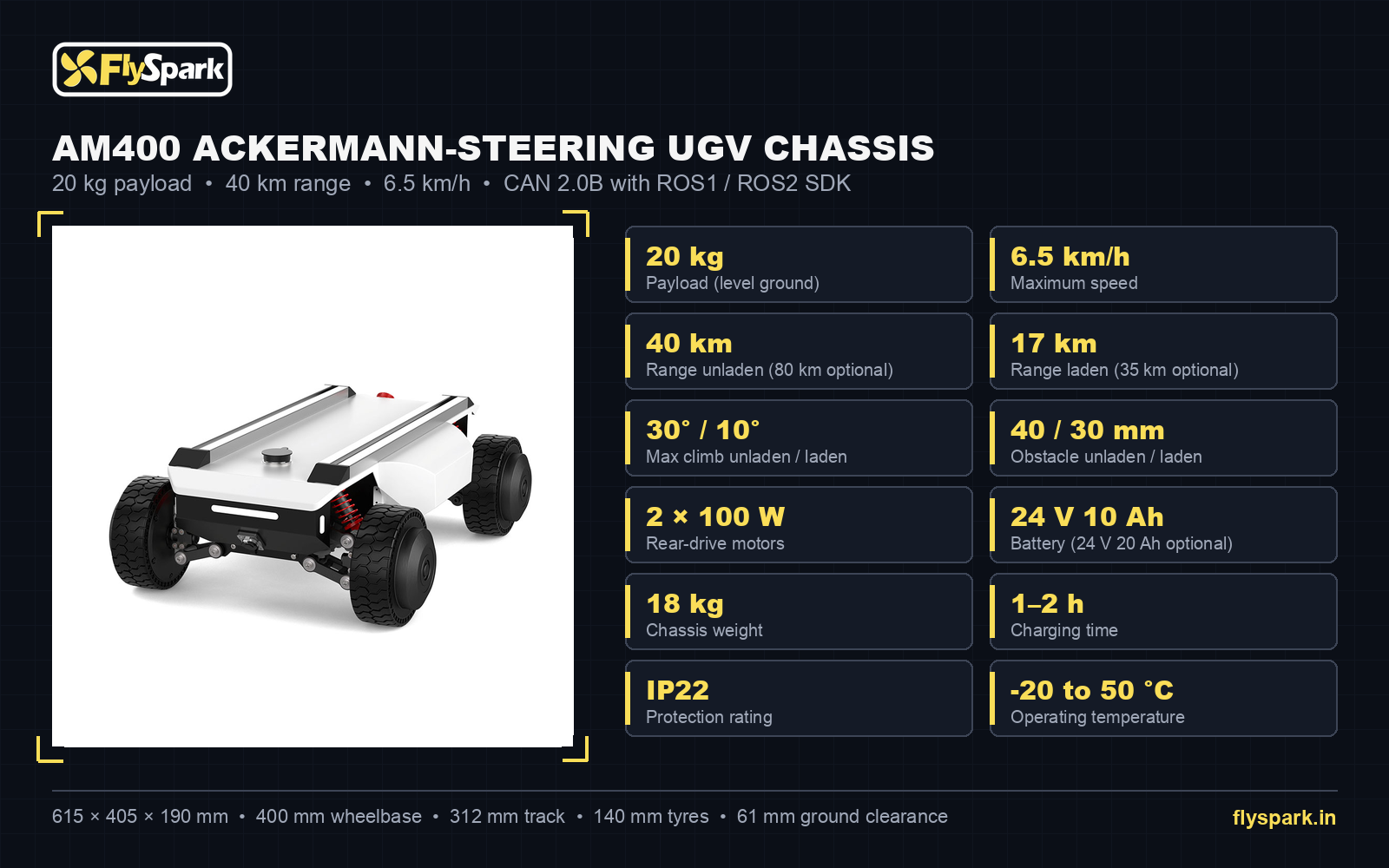
The compact 615 × 405 × 190mm body has a 400mm wheelbase, 312mm wheel track, 140mm tyres and 61mm ground clearance. It climbs 30° slopes unladen (10° laden), steps over 40mm obstacles (30mm laden) and crosses 100mm gaps (90mm laden). It is rated IP22 and operates from -20°C to 50°C in high temperature, at night, and in light rain, wind, light snow and light fog.
WHY CHOOSE THE AM400 ACKERMANN STEERING ROBOT CHASSIS
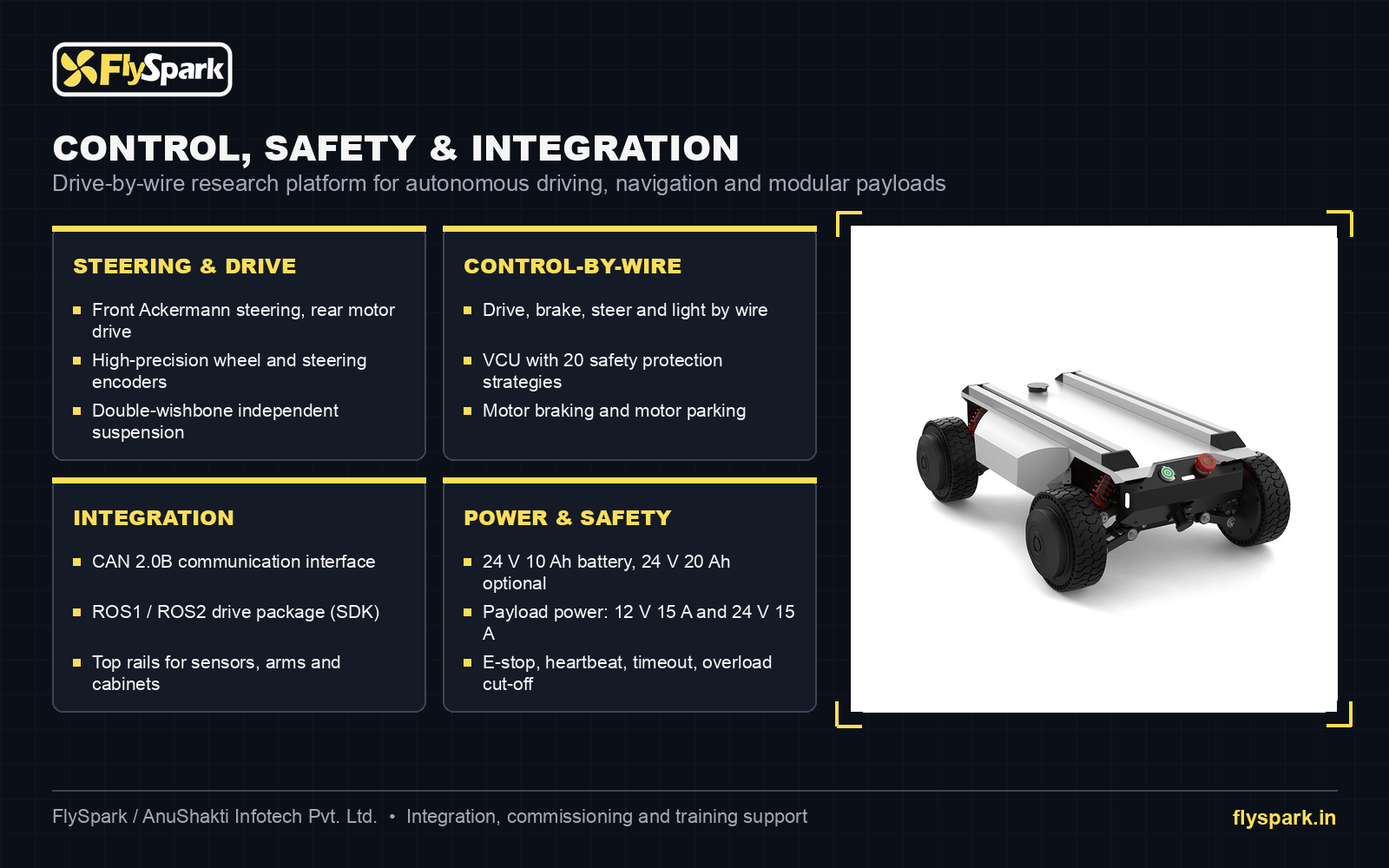
The AM400 is built around a vehicle-grade control-by-wire system: drive-by-wire, brake-by-wire, steer-by-wire (EPS) and light-by-wire, all supervised by a vehicle control unit (VCU) running 20 safety protection strategies. Emergency stop, communication heartbeat, communication timeout, BCC check, overtemperature, overload, short-circuit and steering-limit protection work in both hardware and software, so experimental code cannot easily put the vehicle or the people around it at risk.
AM400 ROS ROBOT CAR PLATFORM INTEGRATION
Integration is straightforward. The chassis talks over CAN 2.0B and ships with a ROS1/ROS2 drive package (SDK) for rapid secondary development, and its power supply provides 12V 15A and 24V 15A outputs for lidar, cameras, computers and displays. Aluminium top rails let you mount robot arms, gimbal cameras, modular cabinets and AI computing modules in minutes, and the detachable vehicle-grade electric control box (EC-BOX) is protected against high and low temperature, water pressure, vibration and salt spray and can be swapped quickly for maintenance or upgrades.
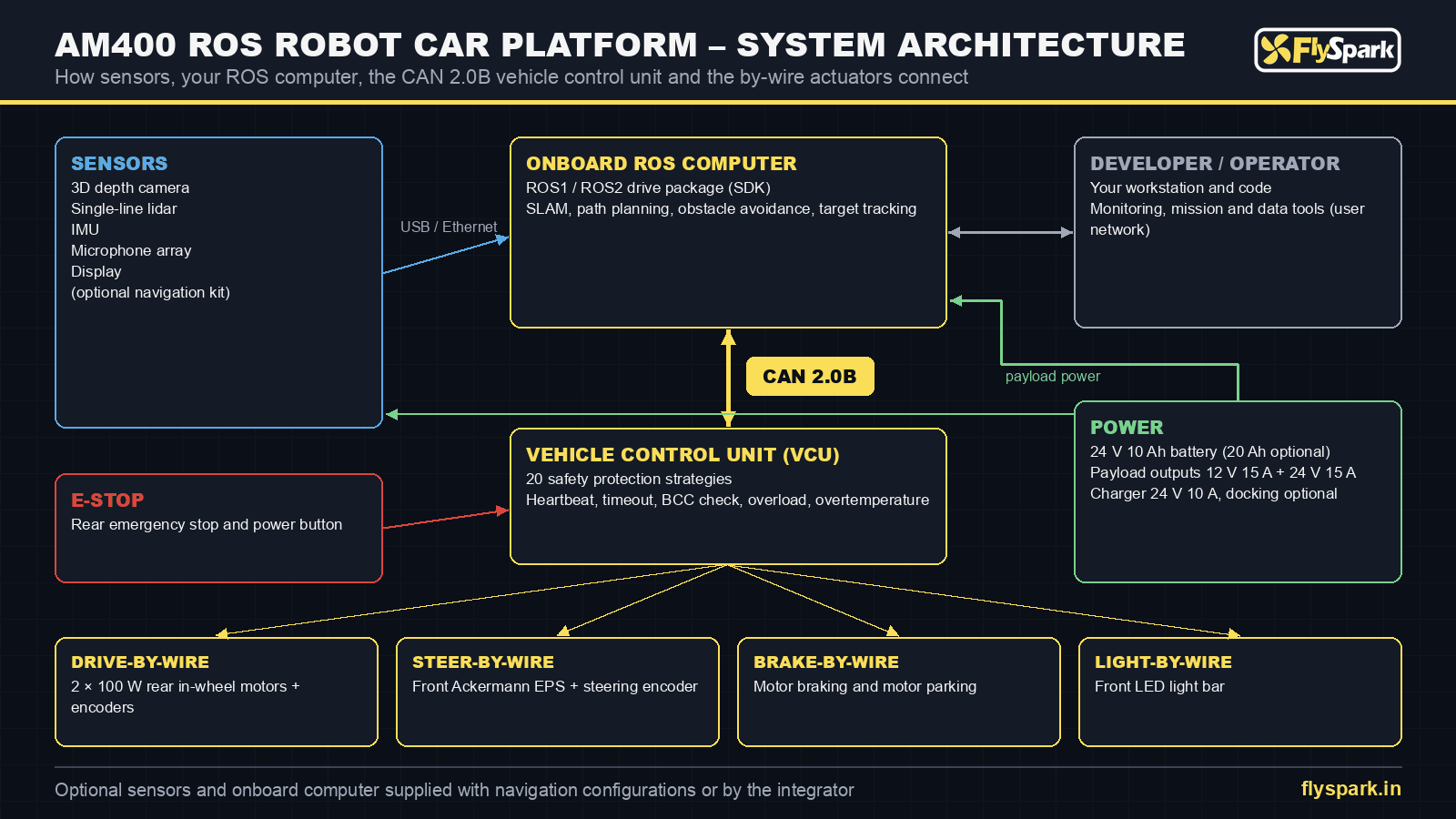
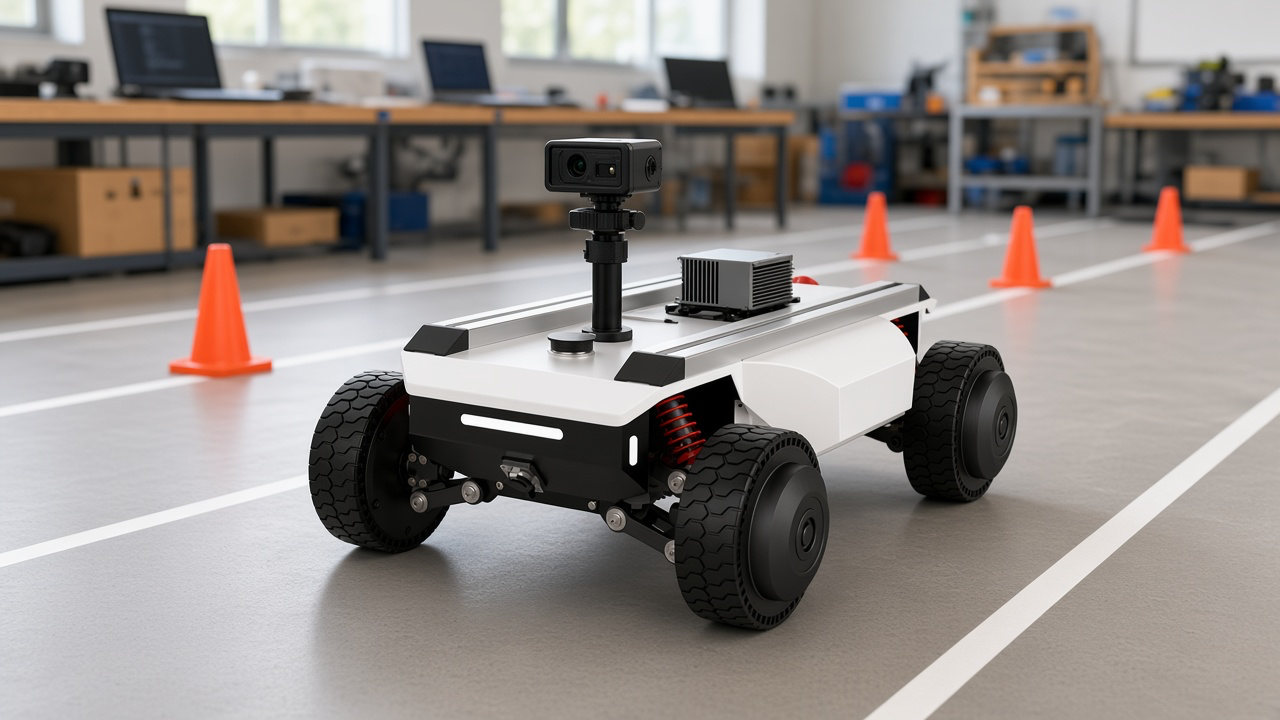
Optional navigation configurations add a 3D depth camera, single-line lidar, IMU, microphone array and display, with intelligent obstacle avoidance, autonomous path planning, 3D visual SLAM, target tracking, multi-robot formation and auto-charging through a docking charging station. An optional course of more than 60 lessons makes the AM400 a complete autonomous driving research robot and teaching platform for intelligent connected vehicles.
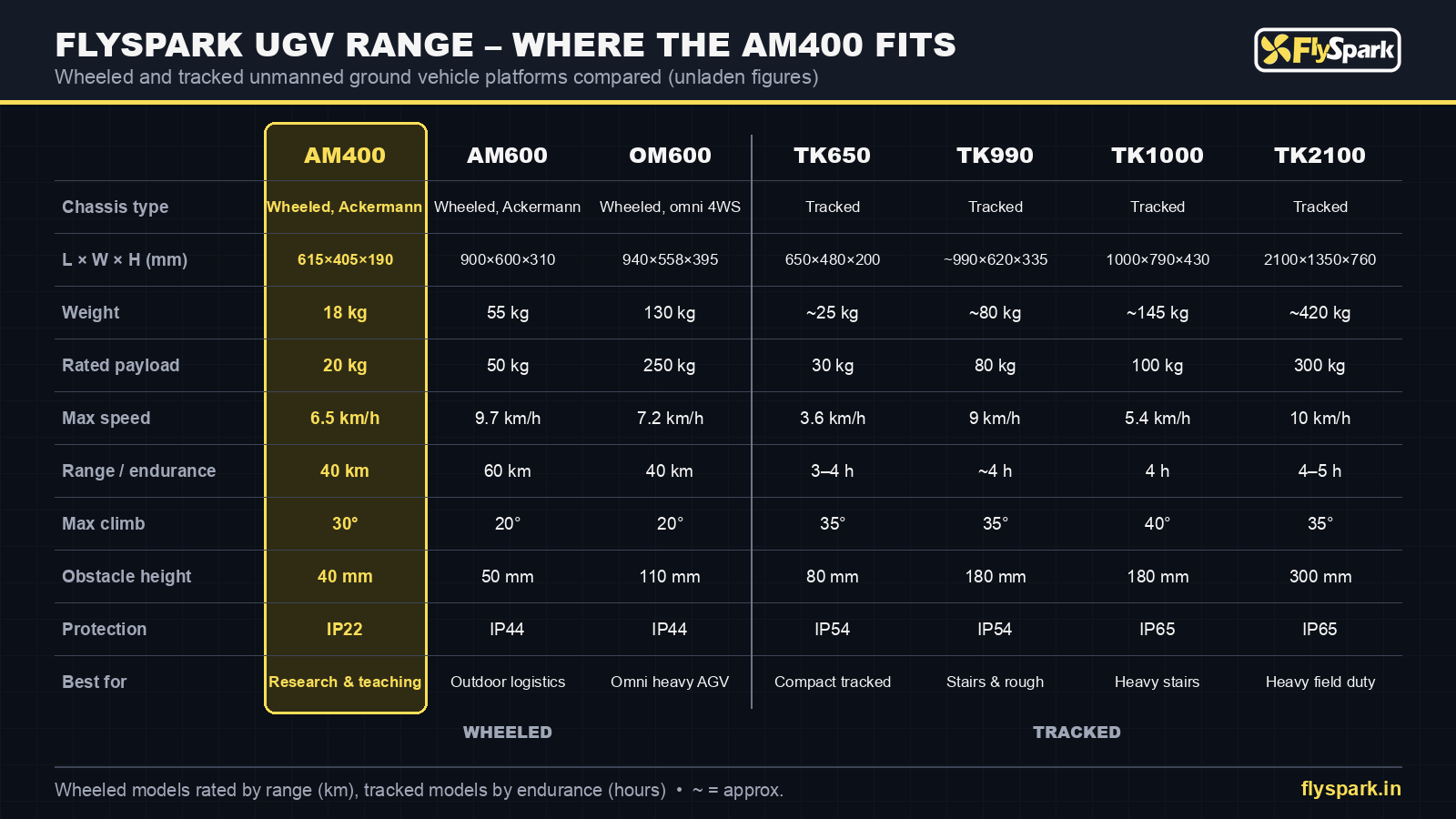
COMPARE THE FLYSPARK UGV RANGE
FlySpark offers wheeled and tracked unmanned ground vehicle chassis that share the same CAN-based integration approach, so a project can start on the AM400 and scale up. Choose the AM400 when you want the smallest, lightest car-like platform; move to a larger wheeled or tracked model when payload, terrain or stairs demand it.
- • FlySpark AM400 – 20kg payload, 40km range, IP22: the lightest Ackermann steering robot chassis for research, teaching and indoor/outdoor prototypes
- • FlySpark AM600 – 50kg payload, 60km range, IP44: larger Ackermann wheeled UGV for outdoor logistics and inspection
- • FlySpark OM600 – 250kg payload, swerve 4WD/4WS omnidirectional drive: heavy mobile-robot base for factories and warehouses
- • FlySpark TK650 – 30kg payload, 35° climb, IP54: compact tracked UGV chassis for rough ground
- • FlySpark TK990 and TK1000 – 80kg and 100kg payload with stair climbing: mid-size tracked UGVs for security and inspection
- • FlySpark TK2100 – 300kg payload, 500mm wading, IP65: heavy-duty tracked UGV for field logistics and defence trials
- KEY FEATURES:
- • Lightweight indoor/outdoor wheeled UGV chassis
- • Front Ackermann steering with rear motor drive
- • High-precision encoders on wheels and steering
- • 20kg payload on level ground
- • 6.5km/h maximum speed
- • 40km range unladen (80km with optional battery)
- • 2 × 100W sealed in-wheel drive motors
- • Double-wishbone independent suspension on all four wheels
- • 30° climbing angle unladen, 10° laden
- • 40mm obstacle clearance unladen, 30mm laden
- • Vehicle-grade drive, brake, steer and light by wire
- • VCU with 20 safety protection strategies
- • Motor braking and motor parking
- • CAN 2.0B interface with ROS1/ROS2 drive package (SDK)
- • 12V 15A and 24V 15A payload power outputs
- • 24V 10Ah battery (24V 20Ah optional), 1–2h charging
- • Modular rail mounting and detachable EC-BOX
- • IP22 protection, -20°C to 50°C operation
- • Optional docking charging station and navigation kits
DEFENCE & MILITARY APPLICATIONS
The AM400 gives defence research and training establishments a safe, low-cost, car-like platform for developing and validating autonomy, sensing and teleoperation before scaling up to larger vehicles.
- • Autonomous-navigation research and algorithm validation for defence R&D labs
- • Indoor and base-perimeter patrol robot prototyping with cameras and lidar
- • Lightweight sensor carrier for CBRN and environmental sensing trials
- • Robot swarming and multi-robot formation experiments
- • Training platform for military engineering and robotics courses
- • Small-load logistics trials inside bases, depots and stores
- • Target-tracking and computer-vision test vehicle
- • Teleoperation and drive-by-wire interface development for larger UGVs
CIVILIAN & COMMERCIAL APPLICATIONS
For universities, industry and smart-city developers, the AM400 is a ready-to-program base for navigation research, inspection robots and light indoor/outdoor logistics.
- • University and school autonomous-driving teaching labs
- • ROS1/ROS2 navigation, SLAM and path-planning research
- • Factory and plant inspection robots
- • Warehouse and intra-logistics delivery prototypes
- • Campus, community and residential patrol robots
- • Chemical warehouse and industrial site monitoring
- • Road-traffic data collection and annotation projects
- • Mobile manipulator bases with lightweight robot arms
- • Smart-city and connected-vehicle demonstrations
- • AI and embodied-intelligence developer platforms
AM400 WHEELED UGV TECHNICAL SPECIFICATIONS AT A GLANCE
- STANDARD SUPPLY:
- • FlySpark AM400 Ackermann-steering chassis with 2 × 100W in-wheel drive motors and encoders
- • 24V 10Ah battery
- • 24V 10A charging adapter
- • Vehicle control unit with CAN 2.0B interface
- • ROS1/ROS2 drive package (SDK) and communication documentation
- • Emergency stop and power switch on the rear panel
- • Operator manual and commissioning support
IMPORTANT USE NOTE: The AM400 is a mobile robot chassis for lawful research, education, inspection, security and logistics applications. Operate it only where you have permission, keep people clear during autonomous testing, respect the 20kg rated payload, IP22 rating and 30mm wading depth, and follow local safety, RF and site regulations. Optional radio and sensor modules must be used only on legally permitted frequencies and power levels.
FREQUENTLY ASKED QUESTIONS:
Q: What is the FlySpark AM400? A: The FlySpark AM400 is a lightweight Ackermann steering robot chassis – a wheeled UGV (unmanned ground vehicle) with front Ackermann steering and rear motor drive. It carries a 20kg payload, reaches 6.5km/h, covers up to 40km per charge unladen and exposes a CAN 2.0B interface with a ROS1/ROS2 drive package, making it a modular base for autonomous-driving research, indoor/outdoor navigation and light logistics robots.
Q: What is an Ackermann steering robot chassis? A: An Ackermann steering robot chassis turns its front wheels at slightly different angles so that all four wheels roll around a common turning centre, just like a passenger car. Compared with skid-steer platforms it reduces tyre scrub, keeps odometry accurate and lets researchers test car-like motion planning and autonomous-driving algorithms on a realistic vehicle model.
Q: What is a wheeled UGV and how does it differ from a tracked UGV? A: A wheeled UGV is an unmanned ground vehicle that rolls on tyres, which makes it quieter, more efficient and gentler on floors and paved roads than a tracked UGV. Tracked UGVs such as the FlySpark TK650 or TK990 climb stairs and cross rough ground better, while a wheeled platform like the AM400 offers longer range per charge and car-like handling.
Q: Is the AM400 a good ROS robot car platform for autonomous driving research? A: Yes. The AM400 combines true Ackermann steering, steer-by-wire and drive-by-wire control, wheel and steering encoders and a CAN 2.0B interface with a ROS1/ROS2 drive package, so it can be used directly as a ROS robot car for SLAM, path planning and autonomous-driving algorithm development.
- Q: What is the payload capacity of the AM400?
- A: The rated payload is 20kg on level ground, mounted on the two aluminium top rails.
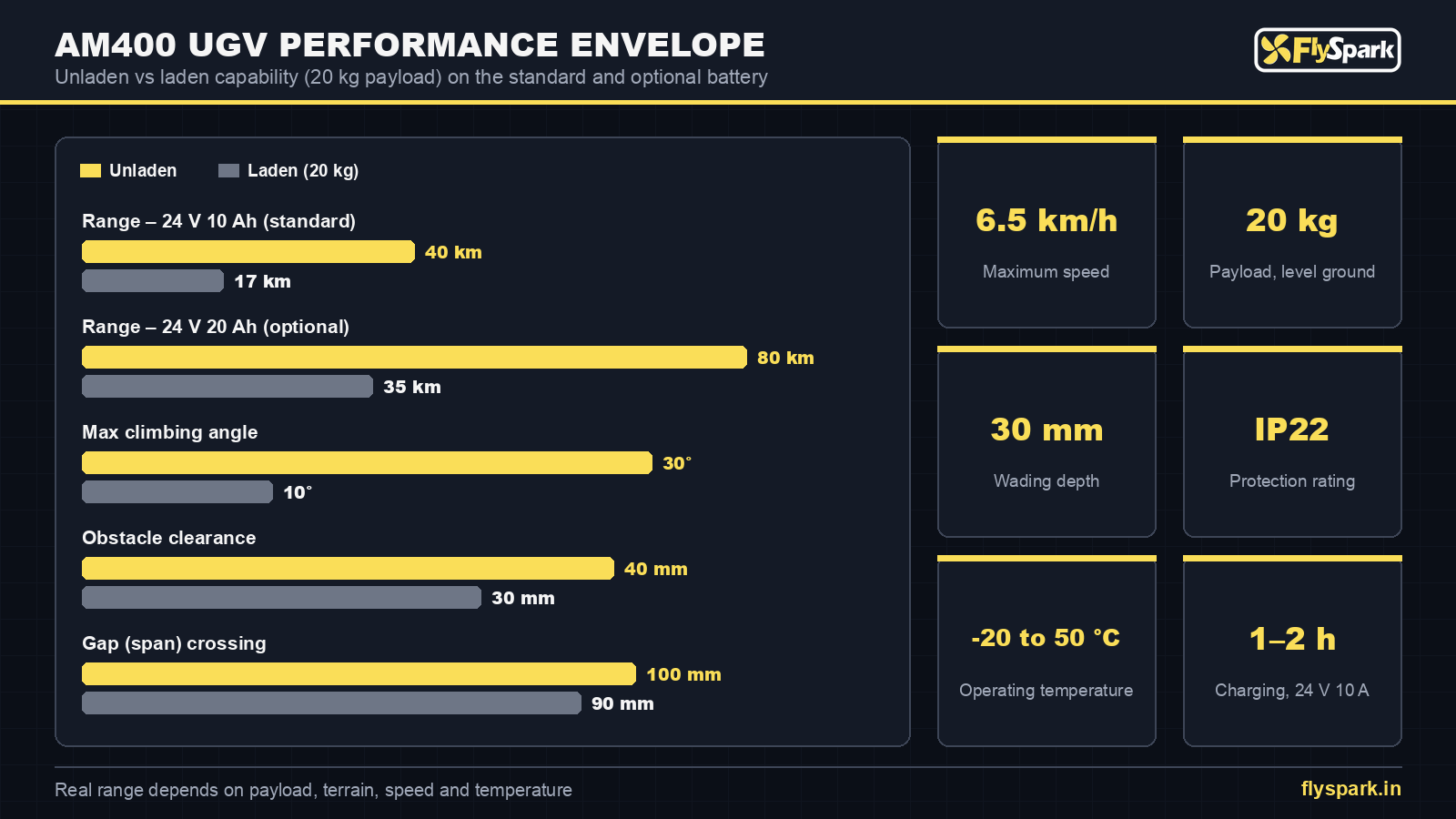
Q: How far does the AM400 travel on one charge? A: With the standard 24V 10Ah battery it covers about 40km unladen or 17km laden. With the optional 24V 20Ah battery the range rises to about 80km unladen or 35km laden. Real range depends on payload, terrain, speed and temperature.
Q: What motors drive the AM400? A: Two 100W in-wheel motors drive the rear wheels, with high-precision encoders on both the drive wheels and the steering system for accurate odometry and closed-loop control.
Q: What terrain can the AM400 handle? A: It climbs slopes up to 30° unladen or 10° laden, steps over obstacles up to 40mm unladen or 30mm laden, and crosses gaps up to 100mm unladen or 90mm laden. Double-wishbone independent suspension on all four wheels absorbs shocks on paving, gravel paths, campus roads and factory floors.
Q: What are the dimensions and weight? A: The chassis measures 615 × 405 × 190mm (L × W × H) and weighs 18kg. Wheelbase is 400mm, wheel track is 312mm, tyre diameter is 140mm and ground clearance is 61mm at the chassis body.
Q: Is the AM400 waterproof and what temperatures can it handle? A: The chassis is rated IP22, which protects against dripping water and light rain, and it operates from -20°C to 50°C in high temperature, at night, and in light rain, wind, light snow and light fog. It is not intended for heavy rain, puddles deeper than its 30mm wading depth or wash-down.
Q: How do I control the AM400 from my own computer? A: The chassis communicates over CAN 2.0B and is supplied with a ROS1/ROS2 drive package (SDK). Your onboard computer sends speed and steering commands and reads back odometry and status, so it plugs straight into ROS navigation stacks, autonomous-driving software and custom research code.
Q: What safety protections are built in? A: A vehicle control unit (VCU) runs 20 safety protection strategies, including emergency stop, communication heartbeat, communication timeout, communication BCC check, overtemperature, overload, short-circuit and steering-limit protection. Braking and parking are both handled by the motors.
- Q: What power outputs are available for sensors and computers?
- A: The power supply provides 12V 15A and 24V 15A outputs for lidar, cameras, onboard computers, displays and other payloads.
Q: How is the battery charged and how long does it take? A: Charging takes 1–2 hours with the 24V 10A charging adapter. An optional docking charging station allows automatic charging for unattended autonomous operation.
Q: Which navigation options are available? A: Optional navigation configurations add sensors such as a 3D depth camera, single-line lidar, IMU, microphone array and display, together with functions such as intelligent obstacle avoidance, autonomous path planning, 3D visual SLAM and navigation, target tracking, multi-robot formation and auto-charging.
Q: Is the AM400 suitable for teaching? A: Yes. An optional course package with more than 60 detailed lessons covers intelligent connected autonomous driving principles, lidar and visual navigation algorithms, road-traffic data collection and annotation, and multi-robot formation navigation.
Q: What can be mounted on the AM400? A: The modular rail mounting design accepts robot arms, gimbal cameras, modular cabinets, AI computing modules, lidar and other sensors. The modular, detachable electric control box (EC-BOX) is built to vehicle-grade standards and can be swapped quickly for maintenance or upgrades.
Q: What is the AM400 robot chassis price in India? A: Price is on request because each AM400 is configured with the battery, navigation kit and accessories you need. Contact FlySpark on WhatsApp or email for a quotation in INR or for export.
Q: What is the lead time, and do you export? A: The AM400 is built on order; lead time is confirmed with your quotation and depends on the chosen battery, navigation kit and accessories. FlySpark supplies customers across India and supports export orders subject to applicable regulations and documentation.
Q: Which FlySpark UGV should I choose instead of the AM400? A: Choose the AM600 for a larger 50kg-payload Ackermann platform with 60km range, the OM600 for a 250kg omnidirectional swerve-drive base, or the TK650, TK990, TK1000 and TK2100 tracked UGVs for rough terrain, stairs and heavier loads. The AM400 is the lightest and most compact option for research and teaching.
Q: Can the AM400 be armed or used for weapons payloads? A: The AM400 is supplied as a research, education and commercial robot chassis and is not designed or rated for weapons. Any defence payload integration must be lawful, may be export-controlled and is the responsibility of the authorised integrator and end user.
Q: Does FlySpark provide integration support and warranty? A: Yes. FlySpark / AnuShakti Infotech Pvt. Ltd. supports sensor and payload integration, ROS onboarding, commissioning and operator training. Warranty covers manufacturing defects for 1 year under approved use and normal operating conditions; damage from overload, water ingress beyond IP22, impact, wrong charging or unauthorized modification may not be covered.
Technical Data Sheet
System Specifications
49 parameters across 7 categories
General
6 fieldsProduct Type
Lightweight Ackermann-steering wheeled UGV robot chassis
Model Name
FlySpark AM400 Ackermann-Steering UGV Robot Chassis
Product Category
Unmanned Ground & Surface Vehicles (UGV / USV)
Price
On request
SKU
FSP-AM400-UGV-STANDARD
Supplier / Integration Support
FlySpark / AnuShakti Infotech Pvt. Ltd.
Complete specification index
Buying FlySpark AM400 Ackermann Steering Robot Chassis | Wheeled UGV, ROS Robot Car, 20kg Payload, 40km Range, 6.5km/h, Drive-by-Wire & CAN 2.0B ROS1/ROS2 SDK from United Kingdom
FlySpark exports FlySpark AM400 Ackermann Steering Robot Chassis | Wheeled UGV, ROS Robot Car, 20kg Payload, 40km Range, 6.5km/h, Drive-by-Wire & CAN 2.0B ROS1/ROS2 SDK to United Kingdom from our facility in Gandhinagar, India. Systems ship on the India → Europe air freight lane with a typical transit time of 7–12 days once documentation clears. Quotes are issued in GBP (EXW Gandhinagar; DAP/CIF on request), and every shipment includes a commercial invoice, packing list and certificate of origin.
- Lead time: 3–6 weeks ex-works, plus 7–12 days transit to United Kingdom
- Import duty and VAT/GST in United Kingdom are payable by the buyer; we declare accurate HS codes and values
- Payment: bank transfer (TT) or letter of credit; 50% advance, balance before dispatch
- Remote commissioning, operator training and spares support in United Kingdom via video call and courier
RF and counter-UAS equipment is supplied to authorized end users only. Depending on United Kingdom regulations an import permit and an end-user certificate (EUC) may be required — our export desk prepares the paperwork with you before dispatch.
Global export · local pricing
FlySpark AM400 Ackermann Steering Robot Chassis | Wheeled UGV, ROS Robot Car, 20kg Payload, 40km Range, 6.5km/h, Drive-by-Wire & CAN 2.0B ROS1/ROS2 SDK — priced for 182+ countries
FlySpark exports this system worldwide with end-user certification, dual-use classification, and destination-specific compliance. Open your country edition for indicative local pricing; the binding quote is issued on WhatsApp in your currency.
Same category
Related systems
Unmanned Ground & Surface Vehicles (UGV / USV)
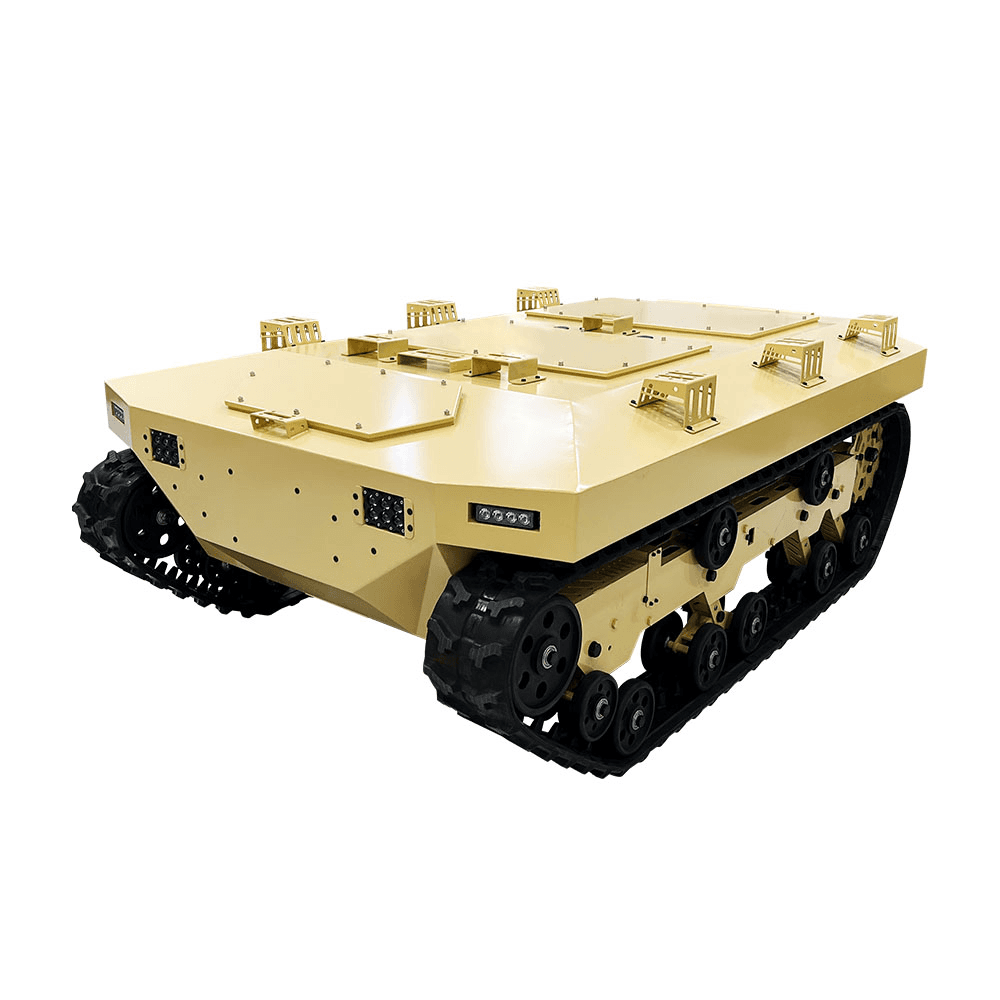
FlySpark TK2100 Heavy-Duty Tracked UGV Robot Chassis | 300kg Payload Unmanned Ground Vehicle, 4–5h Endurance, 500mm Wading, IP65, 2×4500W Drive & ROS-Ready Serial/CAN
Unmanned Ground & Surface Vehicles (UGV / USV)
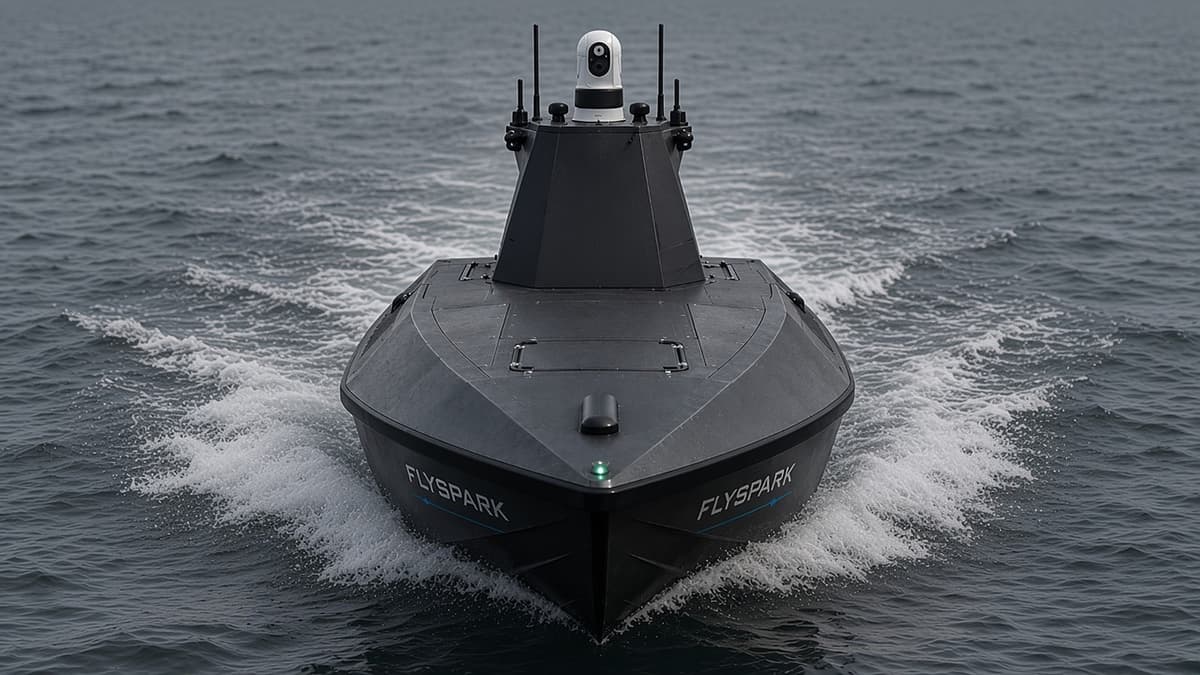
FlySpark SeaScout S8 Uncrewed Surface Vessel (USV) for Maritime Surveillance | 8.4m Low-Signature Hull, 55kt, 650NM Range, 30-Day Endurance, 600kg Payload & Open Autonomy
Unmanned Ground & Surface Vehicles (UGV / USV)
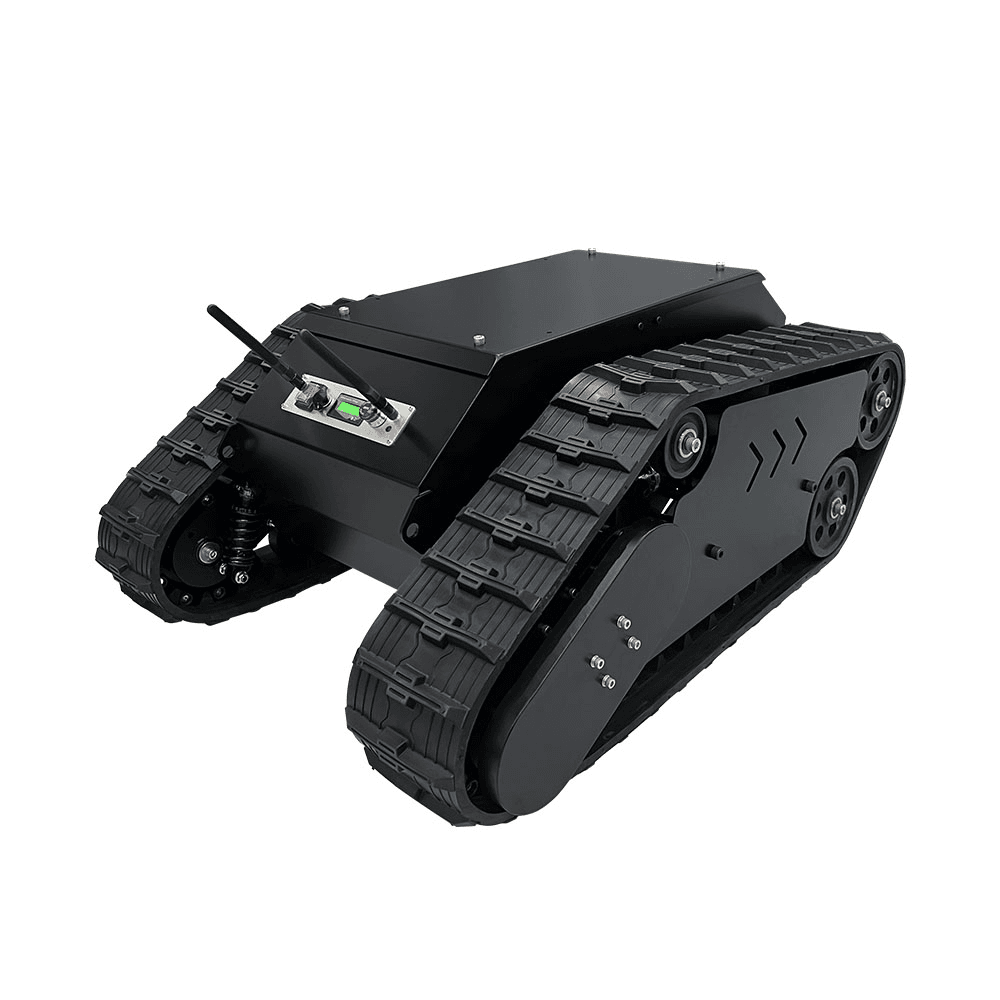
FlySpark TK1000 Stair-Climbing Robot Tank Chassis – Tracked UGV Platform | 100kg Payload, 40° Climb, 180mm Obstacles, 4h Endurance, IP65, 2×1000W Brushless & Serial/CAN
Unmanned Ground & Surface Vehicles (UGV / USV)
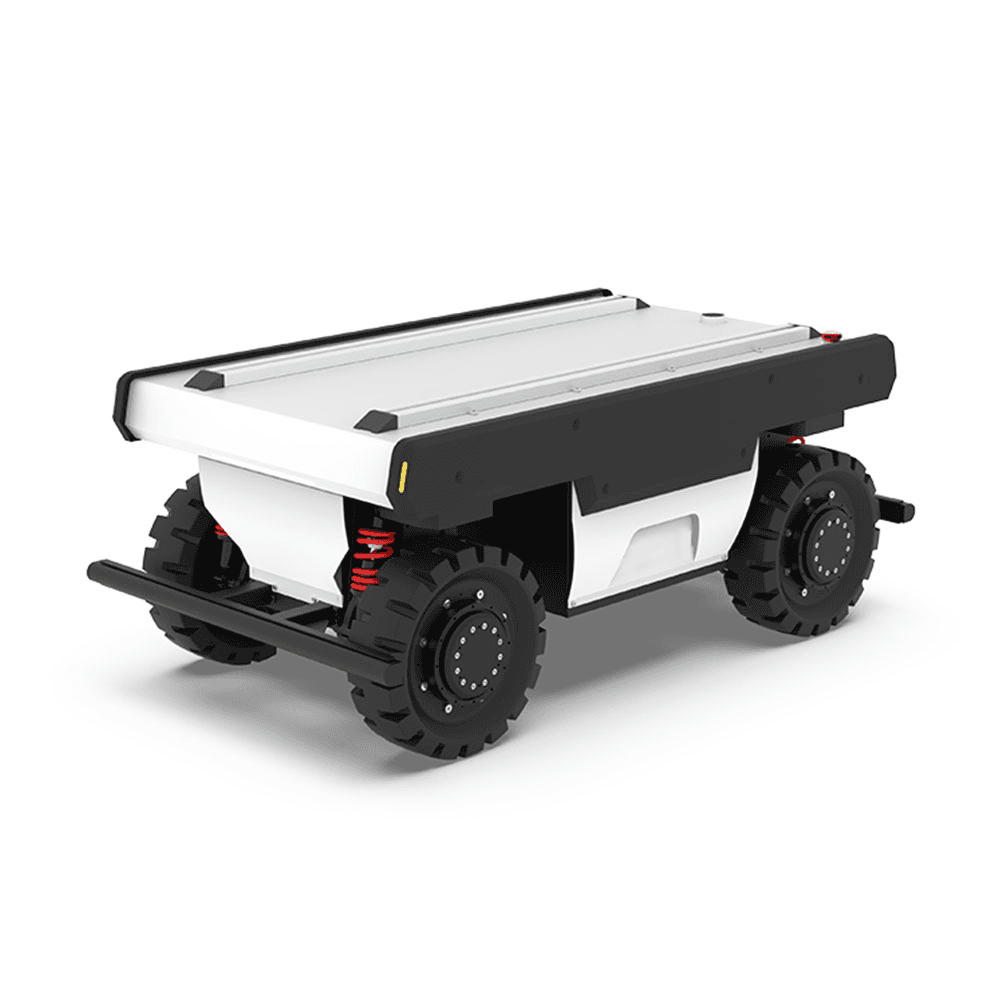
FlySpark OM600 Omnidirectional Robot Chassis – Swerve Drive UGV | 250kg Payload, 4WD/4WS, 40km Range, Zero-Turn & Crab Moving, IP44 & CAN 2.0B ROS1/ROS2 SDK
Frequently asked questions
Can FlySpark export the FlySpark AM400 Ackermann Steering Robot Chassis internationally?
Yes. The FlySpark AM400 Ackermann Steering Robot Chassis ships to defense, security, and critical-infrastructure buyers in 50+ countries with full export documentation — end-user certification, dual-use classification, and destination-specific compliance handled before dispatch.
What configurations of the FlySpark AM400 Ackermann Steering Robot Chassis are available?
The FlySpark AM400 Ackermann Steering Robot Chassis is offered in 5 configurations so you can match range, payload, and integration requirements. Custom builds are available for volume orders.
Do you provide technical support and documentation for the FlySpark AM400 Ackermann Steering Robot Chassis?
Every FlySpark AM400 Ackermann Steering Robot Chassis order includes datasheets, integration guidance, and compliance paperwork. Our engineering team supports commissioning, spares, and field deployment.
How do I request a quote for the FlySpark AM400 Ackermann Steering Robot Chassis?
Pricing for the FlySpark AM400 Ackermann Steering Robot Chassis is quoted on request. Contact the export desk with your quantity and destination for a formal quote that includes export documentation, compliance handling, and freight.
Can FlySpark export FlySpark AM400 Ackermann Steering Robot Chassis | Wheeled UGV, ROS Robot Car, 20kg Payload, 40km Range, 6.5km/h, Drive-by-Wire & CAN 2.0B ROS1/ROS2 SDK to United Kingdom?
Yes. FlySpark ships to United Kingdom on the India → Europe air freight lane; transit is typically 7–12 days. Counter-UAS and RF items require an authorized end user and may need an import permit — we handle the export documentation with you.
What does FlySpark AM400 Ackermann Steering Robot Chassis | Wheeled UGV, ROS Robot Car, 20kg Payload, 40km Range, 6.5km/h, Drive-by-Wire & CAN 2.0B ROS1/ROS2 SDK cost in United Kingdom?
The indicative price is Quote on request (GBP, ex-works India, converted from INR on 2026-10-07). Freight, insurance and United Kingdom import duties are quoted separately; the formal offer is issued in GBP on WhatsApp or email.
How long does delivery to United Kingdom take?
Standard configurations ship in 3–6 weeks after order confirmation; air freight to United Kingdom then takes 7–12 days. Custom builds and larger quantities are scheduled at quotation.
Deployment ready
Ready to Deploy?
Contact our defense engineering team for bulk procurement, customization, compliance documentation and field deployment support.