German airports, energy operators, and Länder police (BOS) have all faced drone incursions, and repeated disruptions at major hubs have pushed counter-UAS from a nice-to-have to a procurement priority. For most German buyers the practical starting point is detection, because active jamming sits under tight spectrum controls.
The regulatory reality in Germany
- Spectrum law — transmitting jammers fall under Bundesnetzagentur authorization; deploying them outside authorized government use is not permitted, which is why passive detection dominates civilian and CNI programs.
- EU dual-use controls — imports are governed by Regulation (EU) 2021/821, so plan for dual-use classification and end-use documentation.
- Data handling — detection logs that capture operator positions should be handled with GDPR in mind.
A detection-led architecture
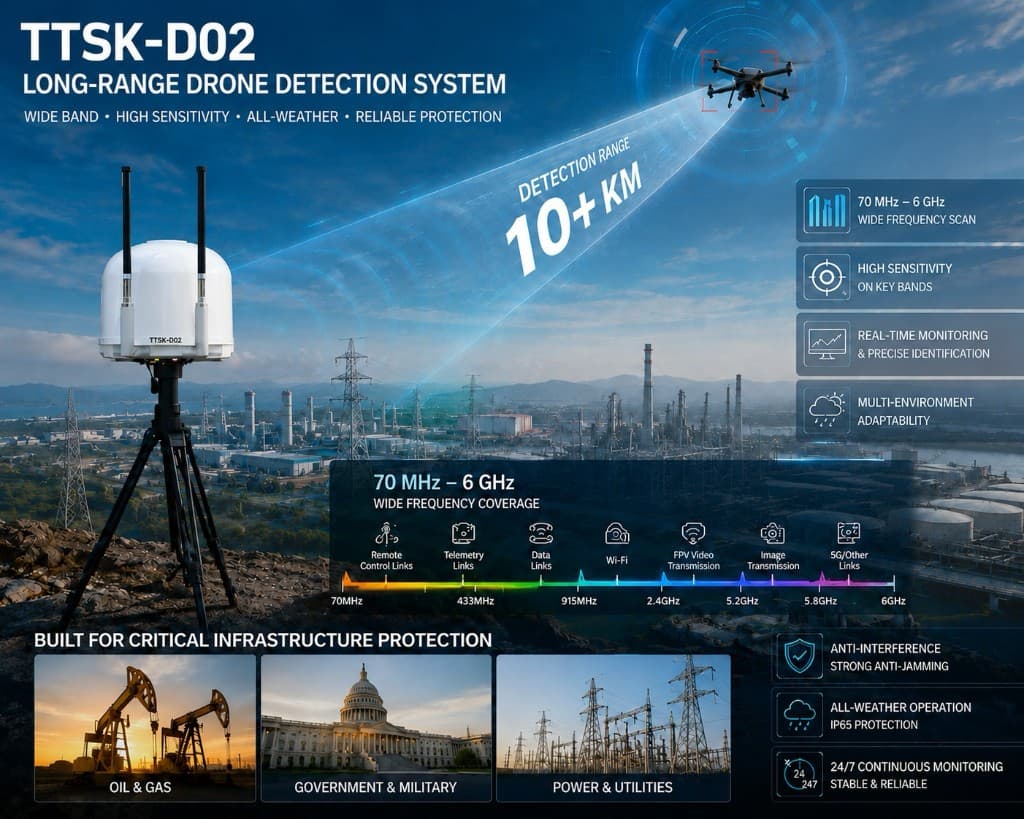
1. Passive RF detection first — a portable drone detector for mobile teams and a fixed 70 MHz–6 GHz system for airport and CNI perimeters. Neither transmits, so both avoid spectrum-authorization hurdles.
2. Track and classify — build airspace awareness and alerting before any mitigation decision.
3. Authorized mitigation — layered escalation such as the HD-2 portable anti-drone system only where the operating authority holds the relevant approvals.
Why this order matters
Detection delivers immediate, legally straightforward situational awareness for Frankfurt- and Munich-scale airspace as well as substations and government sites, while keeping mitigation options open for authorized end users. The Counter-UAS buyers guide and EU dual-use overview cover the layered model and paperwork in more depth.