France protects a dense mix of high-value airspace — Paris-scale airports, major public and sporting events, nuclear and energy sites, and government facilities. Counter-drone capability is now routine in French security planning, and for most operators it begins with passive detection rather than active jamming.
The French regulatory picture
- Spectrum authorization — transmitting jammers fall under ANFR control and authorized state use; passive detection avoids those constraints.
- EU dual-use controls — imports follow Regulation (EU) 2021/821, so prepare dual-use classification and end-use statements.
- Event-driven demand — temporary security perimeters for large events favor rapidly deployable, transmission-free detection.
Recommended architecture
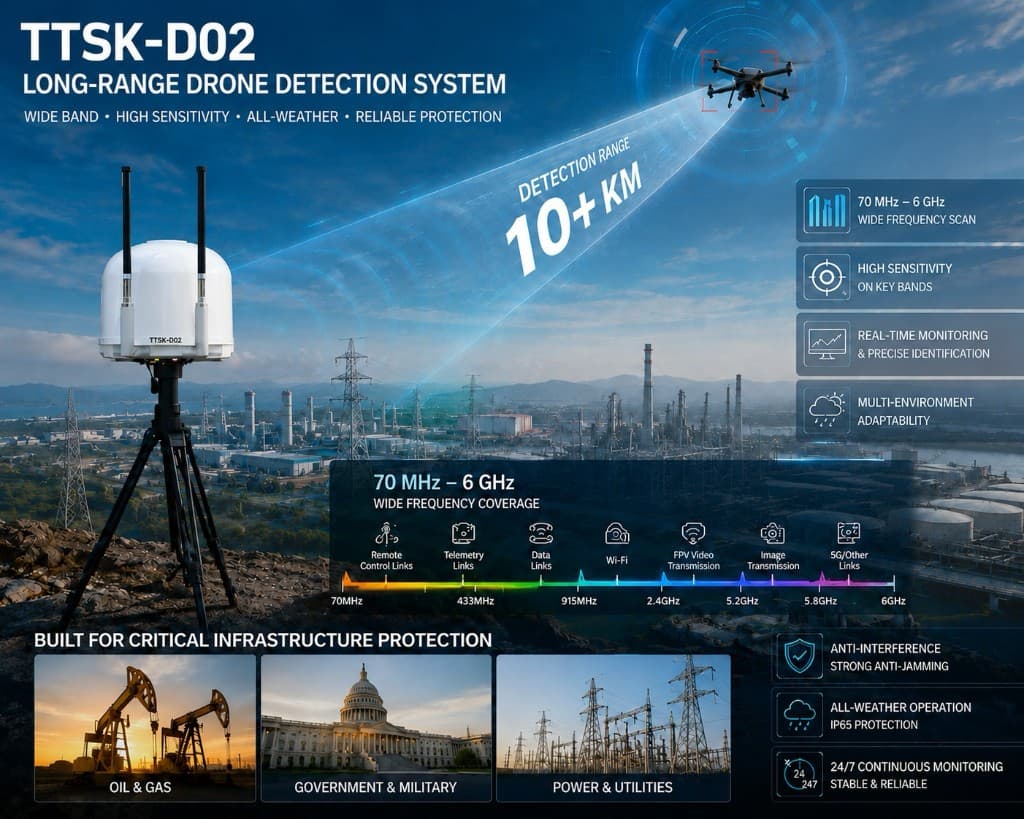
1. Passive RF detection — fixed 70 MHz–6 GHz detection for airports and CNI, plus portable detectors for events and mobile teams.
2. Track and hand off — locate drone and operator, and pass actionable tracks to police or gendarmerie.
3. Authorized mitigation — layered escalation such as the HD-2 portable anti-drone system for cleared end users only.
Why detection-led fits France
Passive detection delivers immediate, legally straightforward coverage for airports, nuclear sites, and event perimeters, while keeping mitigation options open for authorized services. See the Counter-UAS buyers guide and EU dual-use overview for the layered model and paperwork.